There’s a lot of noise around retail media right now. Some of it is justified: it’s a genuinely exciting opportunity to engage shoppers closer to the moment of decision, and it’s a very real new revenue stream for retailers. But it’s also a category of hype that’s ripe for misunderstanding. Over the past couple of years I’ve been working with clients and retailers and helping them change their ways of working to create massive value out of how Retail Media is reshaping retail. In this post I’m sharing some of my key learnings.
Retail Media is coming for you
Before I continue, there is an important point. Many think that Retail Media isn’t important in their market. Or its just a grocery thing. Let’s be clear. If it isn’t in your market yet – it will (and it comes surprisingly fast). And secondly, every retailer on the planet is looking at how they can use media to monetise their shopper traffic. Fashion. Electronics. Health. Pharma. Its coming. Now is the time to start planning, and to learn from the mistakes of those who went before
A while back, Tesco was quoted as saying retail media would be bigger than TV by the end of 2025. It’s a great headline — and I can see why it travels (and I used it for one of my biggest posts of the last few years!)
Is it literally true? Maybe – maybe not…
But that’s the wrong debate.
The more important question is: what does the statment signal? And why does it matter to brand owners?
The hidden implication behind “bigger than TV”
When a retailer compares retail media to TV, it isn’t comparing itself to shopper marketing. It’s comparing itself to the top table of brand budgets. It’s a statement of intent.
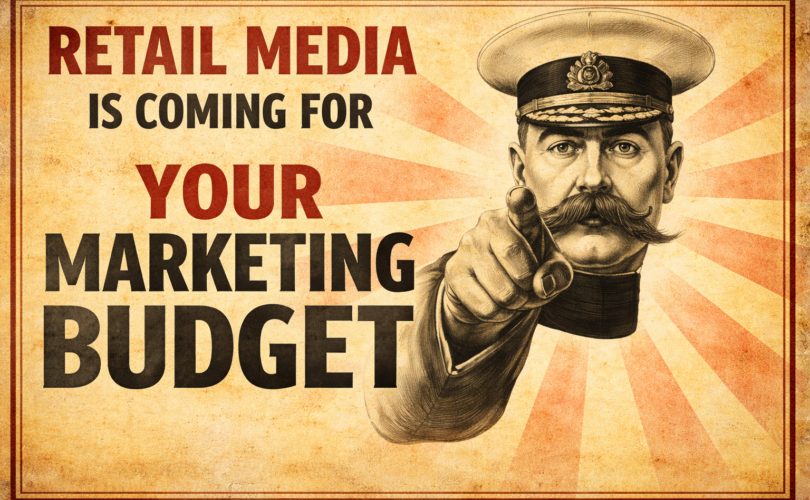
This isn’t an attempt to get brands to spend their shopper and trade funds differently. It’s a direct assault on total marketing spend. Retailers are gunning for your media money.
In plain terms: retail media isn’t just another option for the already-stretched shopper or trade pot. Retailers want incremental spend, and the easiest place to look is the total media budget — including what used to be thought of as “proper marketing”.
That’s why retail media is not simply a sales or e-commerce topic. It’s a marketing topic. A brand topic. A commercial strategy topic. And it’s now forcing organisations to confront how they manage brands, media and customers together.
Because retail media doesn’t just bring new ad formats. It brings new expectations, new negotiations, and a different internal argument about who gets to decide.
Retail media is growing — but it’s growing for a reason
Yes, retail media is growing fast. And yes, part of that growth is driven by better tools: online inventory, loyalty data, and the promise of closed-loop measurement.
But in my experience, the more powerful driver is retailer leverage.
Retailers sit on demand. They sit on shopper attention. They control the environments in which many important decisions are made. And they’re increasingly packaging that into “media” with clear commercial ambition.
That leverage changes behaviour. It makes retail media hard to ignore, regardless of whether the measurement is perfect. It allows (some) retailers to push a product which isn’t as good as it should be, because they have leverage.
It also means that many organisations feel they’re falling behind — and that creates a risk of rushing into spend before they have a model to manage it.
The real danger isn’t being late — it’s spending without a system
I often hear: “We’re late to retail media.” or: “we’re behind”.
Most of the time, you’re not as late as you think. Yes, a few giants are really getting good at this. Even more rushed in and are regretting it. You’re probably not as late as you think, and even if you are, it isn’t necessarily a bad thing.
Many brands are still in “busy but not effective” mode. Lots of activity, lots of reporting, lots of spend — but not a clear view of what’s working, how it compares to other investments, or how to improve it systematically.
The bigger risk isn’t being late. The bigger risk is rushing in and hard-coding bad decisions you’ll regret later — particularly because retail media spend can become surprisingly sticky once it’s embedded in the annual rhythm of plans and JBPs.
Once you’ve given money, it’s harder to give less next year. That’s not because everyone is malicious. It’s because norms form quickly, and expectations are hard to unwind. And… leverage. Retailers are good at it.
So yes, start. But start deliberately. Don’t try to buy your way out of a capability gap.
The big misconception: “this is an ad format conversation”
Most retail media conversations begin with formats: search, display, sponsored products, off-site, in-store screens, retail DSPs.
Formats matter, but they’re not the core challenge.
The core challenge is deciding how retail media fits into your total plan and how you stop it becoming either:
- a permanent “pay-to-play” tax, or
- a tactical sideshow run by one function.
This is why I call retail media an operating model shift.
Because the questions that really matter aren’t “what did we buy?” They’re questions like:
- What are we trying to achieve — short-term, medium-term and long-term?
- How does retail media support the brand plan and the shopper journey?
- Who decides, and based on what evidence?
- How do we compare retail media to other investments — across media, across customers, across levers?
- How do we learn and get better, rather than simply spending more?
If you can’t answer those questions, retail media risks getting marginalised, or lost in organisational politics. Neither of those is a good outcome.
Why retail media causes internal friction
Retail media changes the internal conversation because it sits between worlds.
Marketing directors often see it as tactical and defensive: “retail media can’t build brands — fund it from trade”. Sales teams often feel the retailer pressure and end up in reactive mode: “we need to support this customer; they expect it”. E-commerce teams see it as a performance tool: “we can measure this; it works”.
Finance sees the spend and asks the obvious question: “what is it doing for the business?”
None of those perspectives is completely wrong. The problem is that they’re incomplete — and they’re rarely aligned.
Without shared objectives and a consistent measurement framework, the debate becomes less about effectiveness and more about which function can protect its budget.
Retail media is an opportunity and a tax
Here’s the reality.
It’s an opportunity because it creates new touchpoints to influence shoppers at meaningful moments — online and in-store. Done well, it can support both performance and brand outcomes. Done badly, it becomes a blunt tool for conversion and a drain on broader brand-building.
It’s a tax because retailer leverage is real, norms form quickly, and spend becomes sticky.
You don’t solve that tension by being defensive. And you don’t solve it by rolling over.
You solve it by making retail media earn its place in the total plan.
What strong organisations do differently
Across the best organisations I see — large and challenger — the pattern isn’t glamorous. It’s disciplined.
They anchor retail media in total strategy.
Retail media plans connect to brand plans and customer plans. They start with the journey, not with the budget or retailer requests.
They build a clear operating model.
Decision rights are clear. Planning cadences exist. Roles are defined. There’s a shared language across marketing, sales and e-commerce.
They insist on consistency and comparability.
The KPI question isn’t “what are the magic retail media metrics?” It’s “what are our objectives, and how do we measure consistently across investments?” If retail media has an entirely separate scorecard to everything else, decisions become political and performance becomes hard to compare.
They have a learning agenda.
Retail media produces data. Data is not insight. Insight requires time: review, hypothesise, test, analyse, decide, scale. The best organisations treat retail media as a machine for learning and improvement, not just a machine for spend and reporting.
They don’t confuse ‘partnership’ with romance.
Yes, retailers talk about partnership. But retailers have leverage and commercial goals. Strong organisations work collaboratively, but they set expectations early: data access, transparency, measurement support, and learning commitments. They don’t hope these things appear later.
Where to start: get the foundations right
If you’re feeling pressure to “do more retail media”, here’s the most practical starting point:
- Get clear on what you want to achieve.
- Agree how retail media fits within total media and total customer investment.
- Put simple governance in place so decisions aren’t made in silos.
- Establish a consistent measurement approach so you can compare investment choices.
- Create a learning loop so activity gets better over time, not just bigger.
Retail media can be a powerful growth lever. It can also become a permanent tax.
The difference is whether you treat it as a strategic marketing capability — or as a tactical obligation.
If you’d like it, I’ve built a short Retail Media Readiness Checklist that surfaces the real gaps quickly. If you complete it and share the scores back, I’ll send a simple benchmark view and a few focus areas to prioritise.
And if you’d rather just compare notes, I’m always happy to do a 30-minute call – compare notes and share my thoughts on what you might want to focus on next.